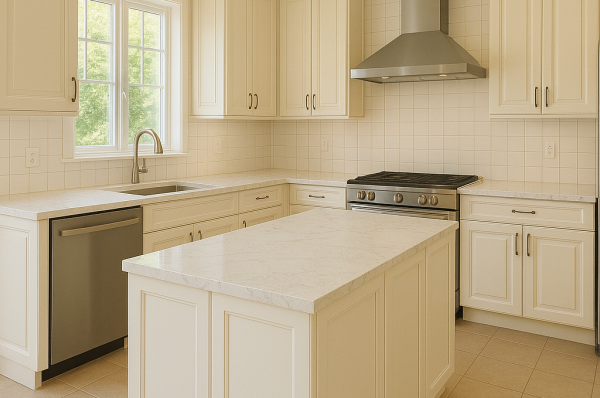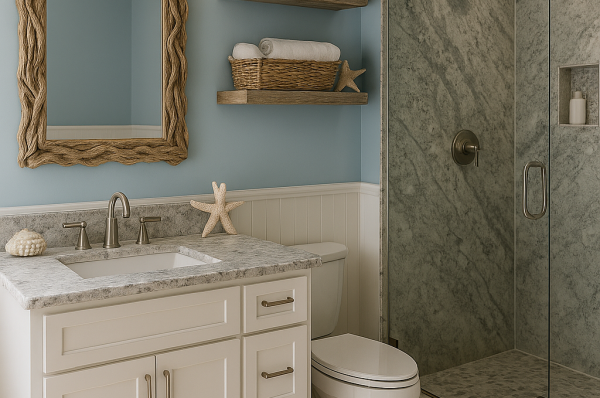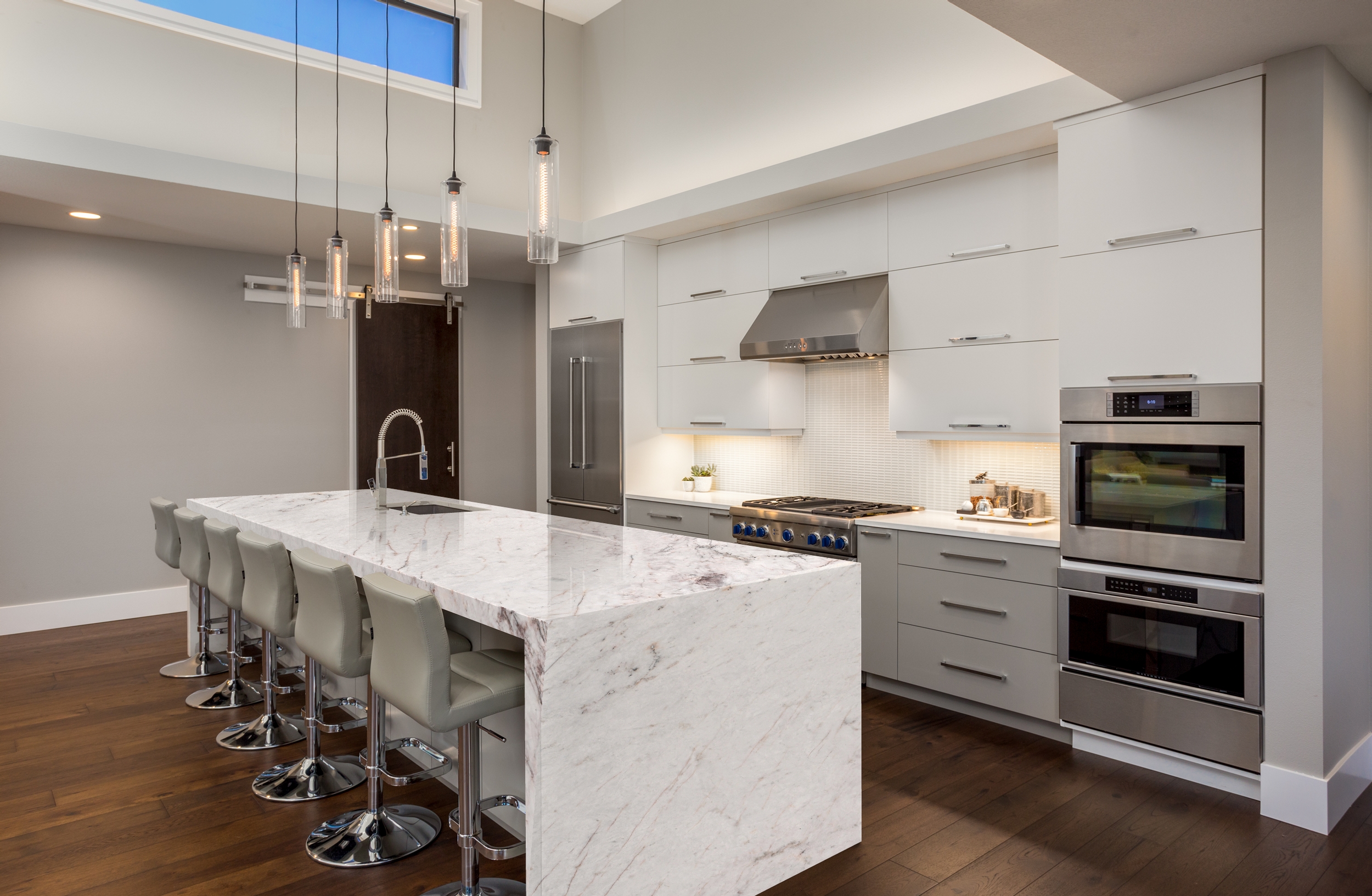
One of the most common worries we hear from homeowners planning a big island or a waterfall-edge counter is the same question, asked a dozen different ways: “Can we avoid a seam altogether?” The honest answer is usually no — but a well-planned seam is nearly invisible, and a poorly planned one is the first thing anyone notices when they walk into the kitchen. The difference comes down to slab math, placement, and a few fabrication techniques that make two pieces of stone read as one.
Why Big Islands Almost Always Need a Seam
Natural stone slabs typically run about 55 to 65 inches wide and 100 to 130 inches long, depending on the material. Once an island’s footprint exceeds roughly 60 inches in either direction — which is most islands built for modern open-concept kitchens — a single slab simply can’t cover it without a seam. Waterfall counters compound this: you’re not just covering the top, you’re wrapping stone down both ends, which uses far more square footage from the slab than people expect.
This isn’t a flaw in the material — it’s physics. The goal isn’t a mythical seamless slab; it’s a seam you have to go looking for.
Where Fabricators Place Seams to Hide Them
Seam placement is where most of the “invisible seam” magic actually happens, and it follows a few consistent rules:
Near the sink or cooktop cutout. Running the seam through a sink opening does double duty — it shortens the visible joint line, and the cutout itself draws the eye away from the seam. It’s the single most common placement trick fabricators use on islands.
Perpendicular to how people view the counter. A seam running front-to-back (away from where people sit or stand) is far less noticeable than one running parallel to the edge you’re facing every day.
Always over solid cabinet support. Seams need continuous support — generally within a few inches on either side — so they’re never placed over open cantilevers or unsupported overhangs, both for visibility and structural reasons.
Away from stress points. Corners near a cooktop cutout are prone to cracking under thermal and structural stress, so experienced fabricators avoid running a joint too close to them.
If you’re working with a designer or fabricator, this is worth discussing at the template stage — not after the slabs are already cut.
Choose a Pattern That Hides the Seam Naturally
Some stones simply disguise seams better than others. Granites and quartzites with a busy, all-over granular pattern — rather than one dominant vein — camouflage a seam because there’s no single sweeping line for your eye to follow and interrupt. Stones with large-scale, dramatic veining (bold marbles and quartzites) look spectacular, but they require careful slab selection so the veining continues logically across the joint — otherwise the seam becomes the focal point instead of the pattern.
This is where buying from a wholesaler with deep slab inventory matters: matching pattern and tone across a seam works best when both pieces come from the same block, or at minimum the same quarry lot. Picking two unrelated slabs off different pallets — even in the “same” color — is one of the most common causes of a seam that stands out.
Bookmatching for Waterfall Edges
Waterfall counters raise the stakes because the seam isn’t hidden on a flat surface — it’s a mitered corner where the vertical and horizontal faces meet, and any misalignment in the grain is immediately visible from across the room.
The premium solution is bookmatching: using two consecutive slabs cut from the same block, opened like a book so the veining mirrors itself across the joint. Done well, the pattern appears to flow continuously from countertop to floor, turning what could be a seam into the design’s centerpiece instead of its flaw. Bookmatching does require sourcing sequential slabs upfront and typically costs more in both material and fabrication time, since layout and cutting have to be planned around the vein rather than for maximum yield.
Mitered Corners vs. Waterfall Drops
For the vertical edge itself, most fabricators use a mitered joint — the stone is cut at a precise 45-degree angle on both pieces so they meet in a clean, seamless-looking corner rather than showing the slab’s raw edge thickness. Done correctly, a mitered corner also makes the stone read as thicker and more substantial than it actually is, which is part of why waterfall islands have such a dramatic presence.
Color-Matched Seam Fill
Even a well-placed, well-matched seam still needs a joint, and this is where fabrication technique closes the gap. Fabricators use a two-part epoxy or polyester adhesive tinted to match the stone’s background color, then route and polish it flush with the surface once cured. It won’t disappear under close inspection, but from normal viewing distance and angle, a properly color-matched, well-placed seam is genuinely hard to find.
One More Lever: Finish
Texture can help too. A honed or leathered finish (we covered the differences in our finish guide) breaks up light reflection across the surface, which can make a seam slightly less noticeable than it would be under a high-gloss polished finish where every joint catches the light.
The Real Key: Plan the Slabs Before You Template
The single biggest factor in how invisible your seam ends up being isn’t the fabricator’s skill at the saw — it’s whether the right slabs were available and reserved before the layout was finalized. That means seeing full slabs in person, checking for consecutive or bookmatched pairs, and confirming pattern continuity before cutting begins, not after.
That’s exactly the kind of decision our showroom is built for. With 300+ slabs in stock across granite, marble, quartzite, quartz, soapstone, porcelain, and Dekton, our team can help you identify bookmatched or sequential slab pairs for your island or waterfall design, and hold them while your fabricator finalizes the template. Visit our warehouse before your project is templated — it’s the easiest way to get a seam nobody will ever notice.