If you’ve spent any time comparing granite, quartzite, marble, and quartz, you’ve probably run into a number attached to each one — something like “granite: 6-7” or “marble: 3-4.” That number is the material’s rating on the Mohs hardness scale, and it’s one of the most useful (and most misunderstood) numbers you’ll come across while countertop shopping. Here’s what it actually measures, how the countertop materials we carry stack up, and — just as important — what it can’t tell you.
What the Mohs Scale Actually Measures
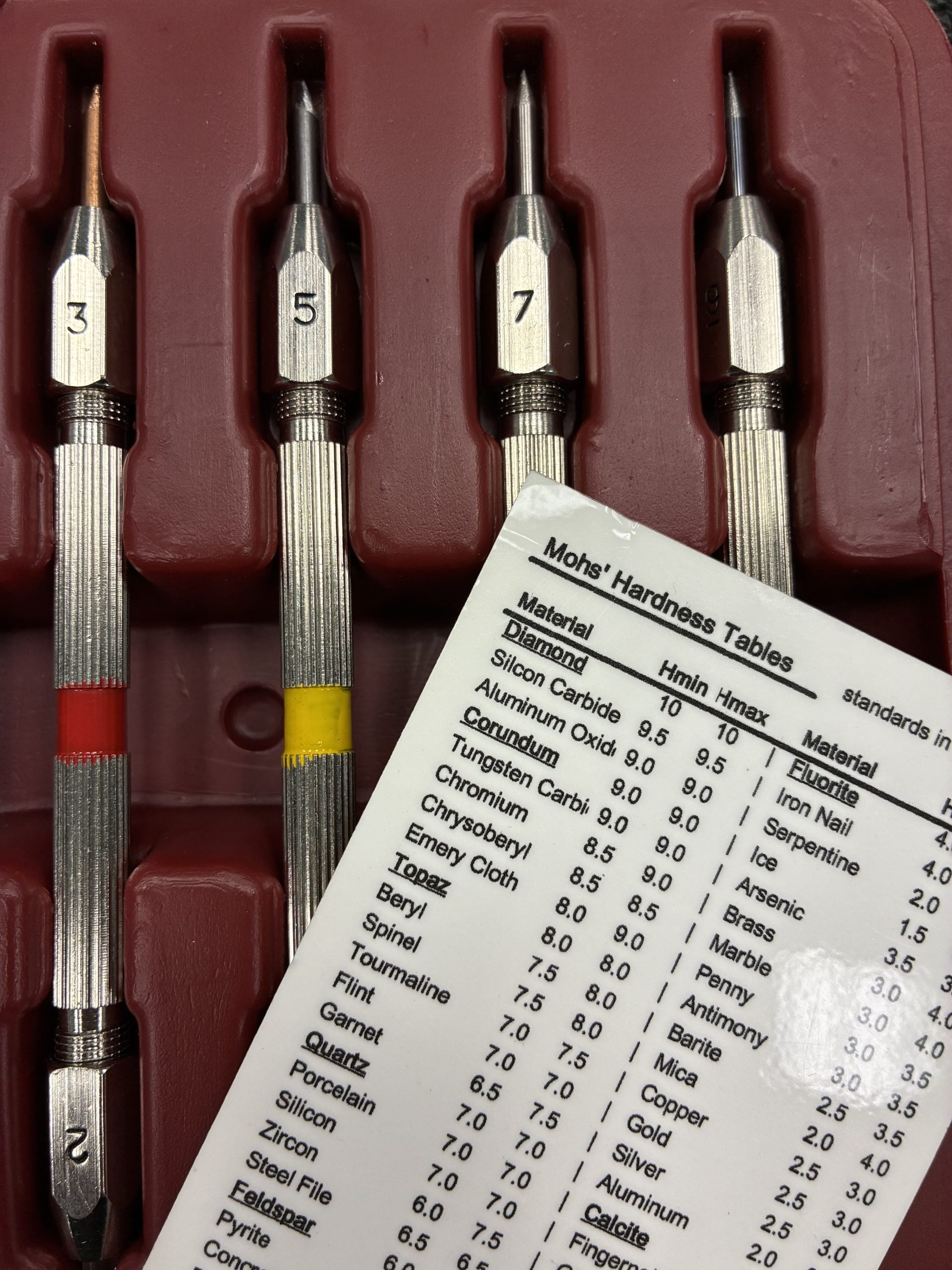
The Mohs scale was developed in 1812 by German geologist Friedrich Mohs as a simple way to rank minerals by scratch resistance. It runs from 1 (softest) to 10 (hardest), and each level is defined by a reference mineral:
| Level | Mineral |
| 1 | Talc |
| 2 | Gypsum |
| 3 | Calcite |
| 4 | Fluorite |
| 5 | Apatite |
| 6 | Orthoclase feldspar |
| 7 | Quartz |
| 8 | Topaz |
| 9 | Corundum |
| 10 | Diamond |
The test itself is simple: a material can scratch anything softer than itself and will be scratched by anything harder. Geologists traditionally worked this out by dragging reference minerals across a sample and seeing what left a mark. For everyday reference, a fingernail sits around 2 to 2.5, a copper coin around 3, a standard steel knife blade or file around 5 to 6.5, and glass somewhere between 4 and 7 depending on the type.
One important nuance: this is a relative scale, not a linear one. The jump from 9 (corundum) to 10 (diamond) represents a far bigger real-world difference in hardness than the jump from 1 to 2. So a stone rated “7” isn’t simply “twice as hard” as one rated “3.5” — it’s considerably harder than that.
| Material | Mohs Hardness |
| Soapstone | 2.5 – 5 (varies by variety) |
| Marble | 3 – 5 |
| Granite | 6 – 7 |
| Quartz | 7 |
| Quartzite | 7+ |
A few things worth noting here. Quartzite regularly matches or exceeds granite in hardness because of how it forms — intense heat and pressure fuse sandstone into a much denser structure. Engineered quartz lands around 7 because it’s manufactured from roughly 90%+ ground natural quartz mineral bound with resin. And soapstone’s range is wider than people expect: some varieties (like Barroca) sit as soft as 2.5, while denser varieties (like Noir) can reach 5 — which matters if you’re comparing two soapstone slabs side by side, not just soapstone against everything else.
How to Actually Use This When Buying
In practical terms, higher Mohs hardness means better resistance to knife marks, dropped pots and pans, and general daily scuffing. If you cook often and use your countertop hard — cutting directly on the surface (not recommended, but it happens), sliding heavy cookware around, prepping with real knife work — a harder material like granite or quartzite will visibly hold up better over years of use than a softer one like marble or soft-variety soapstone.
That’s genuinely useful information. But it’s also where a lot of shoppers stop, and stopping there leads to some avoidable mistakes.
What the Mohs Scale Does NOT Tell You
This is the part that gets skipped in a lot of buying guides, and it matters just as much as the hardness number itself.
Hardness isn’t toughness. Hardness measures resistance to scratching, not resistance to chipping or cracking. A stone can be hard and still be brittle at a thin edge or corner — hardness and impact resistance are related but separate properties.
Hardness says nothing about etching. This is the big one for marble shoppers. Marble’s low hardness rating (3-4) gets it disqualified in a lot of side-by-side comparisons, but the more common complaint from marble owners is actually etching — the dulling that happens when something acidic like lemon juice or wine touches the surface. That’s a chemical reaction with the calcium carbonate in the stone, completely unrelated to Mohs hardness, and it happens on sealed marble just as much as unsealed.
Hardness doesn’t predict stain resistance. That comes down to porosity, not hardness — which is why granite and quartzite still need periodic sealing despite scoring well on this scale, while non-porous engineered quartz needs none at all regardless of its hardness number.
Hardness doesn’t predict heat resistance. Quartz sits right up there with granite and quartzite in hardness, but its resin content means it can scorch above roughly 300°F, something no Mohs number would warn you about.
Don’t assume a high number means zero maintenance. A quartzite countertop rated 7+ still needs sealing and still benefits from prompt cleanup — hardness protects against scratches, not against staining or moisture.
Putting It All Together
The honest way to use the Mohs scale is as one input among several, not the deciding factor on its own. If you want the full picture — hardness alongside sealing needs, heat resistance, stain resistance, and cost — our granite vs. quartzite vs. marble vs. quartz comparison lays all of it out side by side. And if marble’s hardness rating has you hesitant, it’s worth reading how sealing and care actually work for it in our maintenance guide before ruling it out — plenty of people love marble precisely because they’ve made peace with its softness.
The best use of a hardness number isn’t to chase the highest one on the chart. It’s to be honest with yourself about how your kitchen actually gets used, and let that — not a single scratch-resistance rating — drive the decision.
See and Feel the Difference for Yourself
Numbers on a chart only go so far. The best way to understand how a Mohs 3-4 marble actually feels next to a Mohs 7 quartzite is to run your hand across both. With 300+ slabs in stock across granite, marble, quartzite, quartz, soapstone, porcelain, and Dekton, our showroom is set up for exactly that kind of comparison. Visit our warehouse to see how hardness, look, and feel come together before you commit to a slab.